


Table of Contents
- What Makes Custom Cornhole Boards for Serious Players Different
- Regulation Cornhole Board Construction Standards That Matter
- ACL-Approved Cornhole Boards: What the Stamp Means for Tournament Play
- Do Cornhole Board Surface Finishes Wear Out? A Review of Durability
- Vinyl Wraps vs. UV Direct Printing: Which Customization Method Lasts
- Lucky Bags Custom Board Lineup: Models Built for Competitive Play
- Maintenance and Longevity: Keeping Custom Boards Tournament-Ready
- Conclusion
- Frequently Asked Questions
Last Updated: September 20, 2026
What Makes Custom Cornhole Boards for Serious Players Different
Custom cornhole boards for serious players are built to tournament specifications, not backyard convenience. The difference shows up in board weight, surface friction, and frame stability. A regulation board measures 24 by 48 inches with a 6-inch hole placed 9 inches from the top.

Regulation Cornhole Board Construction Standards That Matter
Regulation cornhole board construction standards cover dimensions, materials, and structural bracing. The American Cornhole League (ACL) governs tournament play, and its equipment rules set the baseline serious boards must meet.
The core specs are fixed:
- Top size: 24" x 48"
- Hole diameter: 6", centered 9" from the top edge
- Front height: 3.25"
- Back height: 12"
- Playing surface: smooth enough for consistent slide
American Cornhole League official rules and equipment standards
ACL-Approved Cornhole Boards: What the Stamp Means for Tournament Play
ACL-approved cornhole boards meet the league's equipment requirements and carry a stamp confirming the build was verified. Many events check boards before play, and non-compliant equipment can be rejected at check-in.
What the Stamp Actually Verifies
Most players assume the ACL stamp is a single pass/fail check. In practice, approval covers measurable properties that affect play:
- Top dimensions: 24" x 48" with a 6" hole centered 9" from the top edge
- Board height: 12" at the back, 3.25" at the front
- Surface friction: the top must fall within a playable range, slick enough for a controlled slide, but not so slick that bags skate off the back
- Structural rigidity: the frame must resist flex under a hard, flat throw
- Finish durability: the playing surface must hold its friction profile through repeated bag contact
Why Friction and Rigidity Matter More Than the Stamp Itself
The stamp is a proxy for two things you cannot see in a product photo: surface friction and frame rigidity.
How to Verify a Board Before You Buy
A few simple checks catch most problems:
- Press the center of the top with your palm. If it flexes noticeably, the frame is underbuilt.
- Run a bag across the surface at a moderate speed. It should slide predictably and decelerate evenly, not grab or skate.
- Check the hole edge for a clean, sealed cut. A rough or unsealed edge catches bags and wears faster.
- Look at the underside bracing. Double-braced frames resist bounce; single-brace or open frames do not.
- Confirm the stamp year. Stamps are issued for specific seasons, and an expired stamp may not clear check-in at current events.
If a seller cannot tell you the friction profile or bracing pattern, the board was built for looks rather than play.
American Cornhole League official rules and equipment standards
Do Cornhole Board Surface Finishes Wear Out? A Review of Durability
Cornhole board surface finishes do wear out, and the timeline depends on the coating and storage. A clear-coated tournament surface holds up for years with basic care; a vinyl-wrapped or unsealed top can degrade within a single season.
Here is what shortens a finish's life:
- UV exposure: direct sun breaks down cheap coatings and fades printed graphics
- Moisture: humidity swells wood and lifts edges
- Abrasion: repeated bag contact polishes the slide path
- Improper storage: stacking boards face-to-face scratches the surface
How Friction Changes as a Finish Ages
A finish does not fail all at once. It wears in stages, each changing how the board plays:
Custom Tournament Cornhole Boards →
- Break-in (first few sessions): the clear coat is at its smoothest. Bags slide fast and far, and speed control feels light.
- Settled (weeks to months): the surface develops a consistent friction profile. This is the sweet spot most tournament players prefer.
- Polished path (months to a year): repeated bag contact polishes the area where bags land most. That lane gets slicker than the rest of the board.
- Uneven wear (year-plus): the polished lane and the surrounding surface diverge. Bags behave differently depending on where they land, and your speed control breaks down.
- Coating failure: the clear coat dulls, lifts at the edges, or exposes the print underneath. At this point the board needs a reseal or replacement.
Resealing vs. Replacing: When to Do Which
Resealing is cheaper, but only works if the underlying top is sound.
Reseal when:
- The top is flat and does not flex
- The print or graphics are intact
- The wear is limited to the clear coat
- The board still measures to regulation specs
Replace when:
- The top has warped or developed dead spots
- The print has faded or the vinyl has lifted
- The frame flexes under a hard throw
- The board no longer meets regulation dimensions
Storage and Longevity: What Actually Matters
The thing nobody tells you about board care is that storage matters more than cleaning. A board stored well outlasts a board cleaned daily but left in a damp garage.
- Climate control beats everything. A stable, dry space prevents the wood movement that lifts coatings.
- Vertical storage with airflow beats flat stacking. Flat stacks trap moisture and pressure.
- Never store face-to-face without a protective layer between the tops.
- Keep boards out of direct sun when not in use, even indoors near a window.
- Inspect the clear coat each season for dull spots, lifting edges, or a polished lane.
Maintenance Checklist for Tournament-Ready Boards
- Wipe the surface with a dry microfiber cloth after play to remove grit
- Store boards indoors or in a climate-controlled space
- Keep boards out of direct sun when not in use
- Inspect the clear coat each season for dull spots or lifting
- Check leg braces and hardware for looseness before events
- Never stack boards face-to-face without a protective layer
- Test slide consistency on both boards before a tournament
- Reseal when the polished lane becomes noticeable
Vinyl Wraps vs. UV Direct Printing: Which Customization Method Lasts
UV direct printing outlasts vinyl wraps for tournament play. Direct UV printing bonds full-color graphics into the board surface and seals them under a clear coat; vinyl wraps sit on top, take abrasion directly, and peel at the corners.
| Method | Durability | Surface Feel | Best For |
|---|---|---|---|
| UV Direct Print | Multi-season, fade-resistant | Smooth, sealed into the top | Competitive play, heavy use |
| Vinyl Wrap | 1-2 seasons with care | Slightly raised, can lift | Light backyard use |
| Decal Application | Shortest lifespan | Uneven, prone to peeling | Temporary or display boards |
Lucky Bags Custom Board Lineup: Models Built for Competitive Play
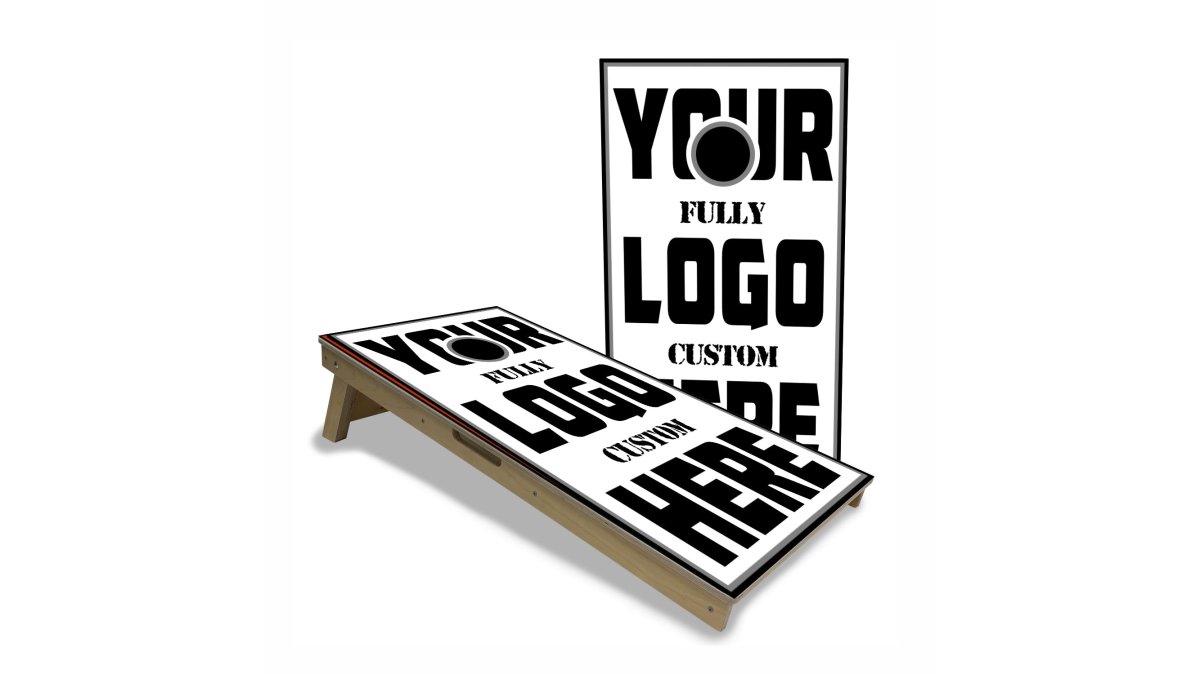
The Lucky Bags Custom Board Lineup starts with the Custom Tournament Cornhole Boards at $449.00. Every board uses regulation-size 24" x 48" tops with a precision 6" hole, 2.6" x 46" x 22" rails, and double-braced undersides that cut bounce.
| Model | Price | Build | Best For |
|---|---|---|---|
| Custom Tournament Boards | $449.00 | Regulation top, double-braced frame | Full custom builds |
| Professional Tournament Series (Set of 2) | $399.99 | 18mm Baltic Birch, UV clear coat | League and tournament play |
| Drip and Clover Designs | $399.00 | Regulation top, UV-printed graphics | Players who want a signature look |
Maintenance and Longevity: Keeping Custom Boards Tournament-Ready
Maintenance keeps a custom board playing the same in year three as in week one. The routine is short, and skipping it shortens a board's life.
- Wipe the surface with a dry microfiber cloth after play to remove grit
- Store boards indoors or in a climate-controlled space
- Keep boards out of direct sun when not in use
- Inspect the clear coat each season for dull spots or lifting
- Check leg braces and hardware for looseness before events
- Never stack boards face-to-face without a protective layer
Conclusion
Buying custom cornhole boards for serious players comes down to specs you can verify: regulation dimensions, cabinet-grade construction, and a finish that holds its slide.
Frequently Asked Questions
What makes a cornhole board professional grade?
Professional-grade boards are built from 18mm (3/4-inch) Baltic Birch plywood, not standard plywood, for consistent strength and minimal flex. They meet regulation dimensions: 24 by 48 inches with a 6-inch hole placed 9 inches from the top. The playing surface is sealed with a UV clear coat for consistent slide, and the frame uses dual support braces to eliminate bounce. Custom cornhole boards for serious players also include features like leg braces, carrying handles, and precision CNC-cut parts for accuracy.
Do professional cornhole players use custom boards?
Yes. Many ACL competitors use custom boards to match their team colors, sponsor logos, or personal style while maintaining tournament-legal specs. Custom printing does not affect play if the surface is properly sealed. Boards like the Lucky Bags Professional Tournament Series allow different designs on each board in a set at no extra charge, so players can represent their team or brand without sacrificing performance.
How do you maintain the surface of tournament cornhole boards?
Keep the playing surface clean with a soft cloth. Store boards indoors or in a weather-resistant cover when not in use. Check for scratches or wear every few months, especially if you play on rough surfaces. Proper care extends the life of your custom cornhole boards and preserves slide control.
What are the official dimensions for regulation cornhole boards?
Regulation cornhole boards measure 24 inches wide by 48 inches long. The hole is 6 inches in diameter and centered 9 inches from the top edge. The front height is 3.25 inches, and the back height is 12 inches, creating the standard playing angle. These dimensions apply to ACL-approved cornhole boards and are required for tournament play. Lucky Bags boards meet all these specs, including the 2.6-inch by 46-inch by 22-inch rails for a solid frame.
What is the difference between cabinet-grade plywood and standard plywood for boards?
Cabinet-grade plywood, such as 18mm Baltic Birch, has more layers and fewer voids than standard plywood. This gives it greater structural integrity, less flex, and a smoother surface for consistent bag slide. Standard plywood can warp or develop soft spots over time, especially with weather exposure. For serious players, cabinet-grade plywood is the baseline for custom cornhole boards that hold up to tournament use and repeated travel.