


Table of Contents
- Comparison Table: Tournament Board Materials at a Glance
- The Best Plywood for Cornhole Boards: Baltic Birch vs. Cabinet-Grade vs. MDF
- ACL Approved Cornhole Board Specifications You Need to Know
- Do Cornhole Board Surface Finishes Wear Out?
- Structural Integrity: Why Bounce and Vibration Kill Your Game
- Weight-to-Stability Ratio and Acoustic Performance
- Weather Resistance and Outdoor Durability
- Conclusion
- Frequently Asked Questions
Last Updated: September 11, 2026
Comparison Table: Tournament Board Materials at a Glance
The best cornhole board materials for tournaments come down to one non-negotiable: an 18mm (3/4") Baltic Birch plywood playing surface with a void-free core, mounted on a braced frame that kills bounce, and no other cornhole board materials come close. Here is how the main options stack up.
| Material | Surface Speed | Bounce Resistance | Weather Tolerance | Best For |
|---|---|---|---|---|
| Baltic Birch plywood (18mm) | Fast, consistent | Excellent | Good with sealing | Tournament and league play |
| Cabinet-grade plywood | Moderate | Good | Moderate | Recreational backyard sets |
| MDF | Slow, variable | Poor | Very poor | Indoor casual use only |
| Composite/plastic | Fast but slick | Fair | Excellent | Portable travel sets |
At Lucky Bags Cornhole, we build every Tournament Series board on 18mm Baltic Birch because that is the material that survives a full ACL season without the playing surface softening.

The Best Plywood for Cornhole Boards: Baltic Birch vs. Cabinet-Grade vs. MDF
Baltic Birch is the best plywood for cornhole boards because its core is void-free and its plies are cross-grained, keeping the surface flat under repeated impact. Cabinet-grade plywood is a reasonable second choice; MDF fails once humidity and bag impact enter the picture. A void (a hollow pocket inside the plywood) flexes under impact, sending a well-thrown bag hopping off line, while Baltic Birch's tightly bonded plies resist that compression and stay true across thousands of throws.
Why Baltic Birch Is the Tournament Standard
Tournament-grade cornhole boards are built on Baltic Birch because its cross-grain construction spreads impact stress across multiple layers instead of one spot. Three properties separate it from the pack:

- Void-free core: no hidden gaps to flex or delaminate under a 15-ounce bag
- Consistent thickness: 18mm stays 18mm, so the playing surface never warps unevenly
- Impact resistance: the layered plies absorb repeated hits without denting
That is also why the American Cornhole League official rules specify a rigid, flat surface. The material is not a style preference, it is a performance requirement.
MDF vs. Plywood: Performance Comparison
MDF loses to plywood for tournament play on every meaningful measure: it is uniform and cheap, but heavy, brittle, and highly vulnerable to moisture.
Where MDF fails:
- Swells and crumbles when it absorbs humidity
- Dents permanently under bag impact
- Cannot be recoated reliably once the surface breaks down
Baltic Birch holds its shape, finish, and up to a season of competitive use. Beyond a covered patio, the choice is not close.
ACL Approved Cornhole Board Specifications You Need to Know
ACL approved cornhole board specifications require a 24" x 48" playing surface, a 6" diameter hole centered 9" from the top edge, a 12" rear height, and a 3.25" front height (americancornhole.com). These dimensions are the baseline for legal tournament play. Any board you bring to a sanctioned event has to hit those numbers exactly, a surface a half-inch off or a hole that drifts from center gets flagged at check-in, and no amount of skill compensates for illegal equipment.
Board Thickness and Regulation Requirements
The regulation playing surface thickness for competitive boards is 18mm, or 3/4 inch, giving the top enough rigidity to resist flex while staying light enough to carry (americancornhole.com). A thinner top flexes under impact, robbing energy from the bag and changing its slide, while a thicker top adds weight without meaningful stability. The 3/4 inch standard is the sweet spot, and it is the thickness every Lucky Bags Tournament Series board uses.
Do Cornhole Board Surface Finishes Wear Out?
Yes, cornhole board surface finishes wear out gradually. A polyurethane or UV clear coat slowly loses its slickness as dust, bag friction, and UV exposure break down the top layer, and the board plays slower than when new. You will usually notice it before you can see it: bags that used to slide cleanly start grabbing, and your release feels the same but the result changes. That is the finish talking, not your arm.
Surface Coating Compatibility: Why the Substrate Dictates the Finish
The material under the finish determines which coatings bond, how many coats the surface absorbs, and how the finished board plays. A finish that works on one substrate can fish-eye, soak in unevenly, or peel on another.
Baltic Birch. The tight, void-free face veneer is nearly non-porous, so it takes a thin, even coat and cures to a hard, fast surface. Water-based polycrylic lays down cleanly and dries fast but builds a thinner film, so it plays faster and wears through sooner. Oil-based polyurethane and lacquer build a thicker, more durable film with a slightly slower, more controlled slide, which is why many tournament builders favor them for a surface that has to hold its speed across a full season. Because the veneer is uniform, the finish cures consistently across the whole 24" x 48" face, avoiding the fast patch / slow patch inconsistency that plagues cheaper tops.
Pine and other open-grained softwoods. These species drink finish: earlywood and latewood absorb at different rates, so the cured film ends up uneven and the board plays fast down one grain line and grabs across another. A sanding sealer or build coats can compensate, but you are fighting the material, and the finish is more likely to crack along the grain as the softwood expands and contracts with humidity.
MDF. The uniform, resin-bound surface is smooth and takes a finish evenly, which is why MDF boards feel deceptively fast when new. The problem is moisture: MDF swells at the edges and around the hole, lifting and cracking the finish from underneath. Once the coating breaks, the exposed fiber absorbs water and the surface turns to mush. No topcoat fully solves this, because the failure starts in the substrate, not the film.
Recoating Without Ruining the Surface
Recoating only works if the new finish is compatible with what is already on the board. Polyurethane bonds to polyurethane; a water-based topcoat over oil-based finish can blister or peel; lacquer over polyurethane will not adhere. If you do not know what is on the board, test a small hidden area first.
Before recoating:
- Confirm what finish is currently on the surface
- Scuff the existing coat lightly so the new finish has something to bite
- Clean thoroughly and let the board dry completely
- Apply thin, even coats and let each one cure fully before the next
A factory UV clear coat, like the one on Lucky Bags boards, is engineered for the specific substrate underneath it. That pairing, finish matched to a void-free Baltic Birch face, buys a longer window before recoating, and it is why a properly finished Baltic Birch top holds its speed longer than the same coating sprayed over pine or MDF.
Structural Integrity: Why Bounce and Vibration Kill Your Game
Bounce and vibration destroy accuracy because they add an uncontrolled variable to every throw. When a bag lands on a board that flexes, the surface returns energy upward and the bag hops instead of settling. You cannot aim around a moving target.
The Mechanics of Impact: Where the Energy Goes
A 15-ounce bag landing at throwing speed carries real kinetic energy. On a well-built board it dissipates as sound, bag-fill shift, and energy spread through the top and frame; on a poorly built board, a meaningful share rebounds upward and makes the bag skip. The material and structure determine the path that energy takes:
- Void-free core. In Baltic Birch, cross-grained plies and the absence of internal gaps spread impact stress laterally instead of concentrating it at a weak point. A void acts like a hinge: the surface dips, stores energy, then springs back and kicks the bag.
- Panel thickness. An 18mm top has enough section stiffness to resist local deflection under a bag strike. A thinner top flexes more at impact, robbing the bag of forward slide and adding rebound.
- Bracing geometry. The top only stays flat if what is under it stays rigid. A single center brace leaves two unsupported spans free to drum; dual braces running the length of the board shorten those spans and raise the frequency at which the top wants to vibrate, keeping it from resonating with the impact.
- Frame joinery and contact points. Loose joints and sharp, hard edges create rattle and chip points. Rounded edges and corners on the frame and braces reduce the sharp contact points that crack and loosen over a season.
Diagnosing Bounce Before You Buy
You can test a board's structural integrity in thirty seconds without throwing a bag:
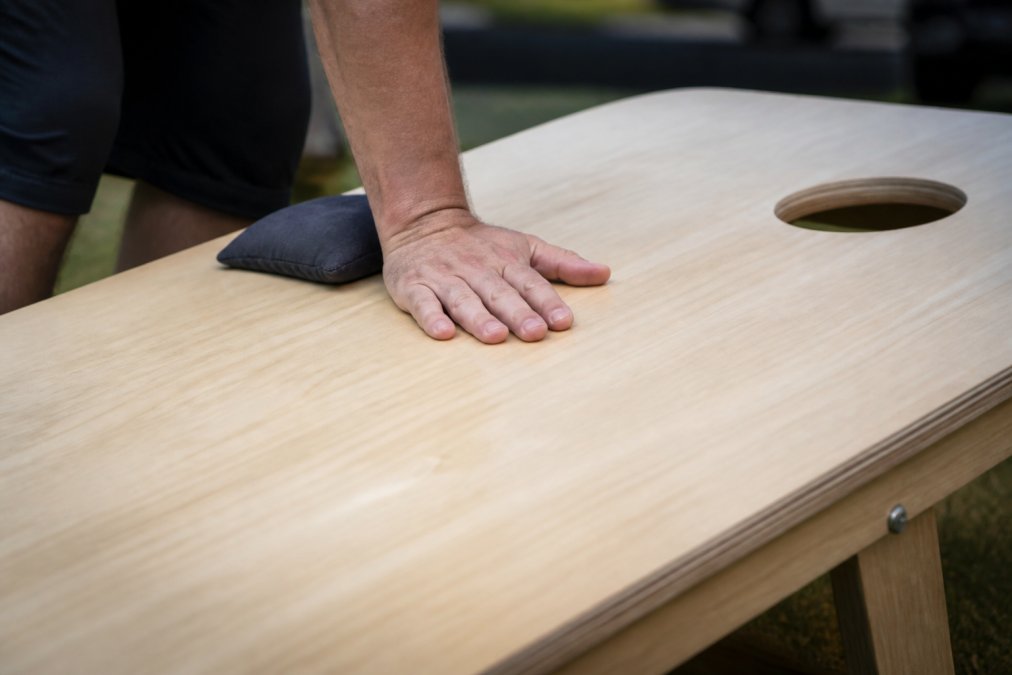
- Press test. Press a palm firmly on the center of the playing surface. A tournament-grade top should feel like a table, not a trampoline. Any give you can feel by hand will be far worse under a bag.
- Tap test. Rap your knuckles across the surface from front to back. A solid, well-braced top returns a consistent, deadened thud everywhere. A hollow ring or a change in pitch points to a void in the core or a gap between the top and a brace.
- Rattle test. Give the board a gentle shake. Any rattle means a loose brace or fastener, a future bounce point.
- Edge test. Look at the exposed plies on the edge of the top. Tight, uniform layers with no visible gaps confirm a void-free core. Gaps or dark pockets are voids waiting to flex.
A common mistake is buying a board with a great-looking top and a weak frame. The top gets the attention, but the frame keeps it flat, and the frame is where cheap boards cut corners first.
Lucky Bags addresses both with a double-braced underside and integrated carry handles on both frame sides, so the board stays rigid in play and easy to move between matches.
Weight-to-Stability Ratio and Acoustic Performance
The weight-to-stability ratio is the balance between a board light enough to carry and heavy enough to stay planted. Tournament players generally find 25 to 35 pounds per unit hits that balance, staying portable without sliding on impact.
Acoustic performance is the angle almost no guide covers. A dull thud usually means a solid, well-braced top, while a hollow ring or rattle points to a void in the core or a loose brace, both signals of future flex.
Lucky Bags addresses both with a double-braced underside and integrated carry handles on both frame sides, so the board stays rigid in play and easy to move between matches.
Weather Resistance and Outdoor Durability
Weather-resistant cornhole boards survive humidity, temperature swings, and UV exposure without warping or delaminating. Material and finish both have to do their job, because a sealed board on a poor substrate will still fail.

Baltic Birch handles moisture far better than MDF, but it still needs protection. A proper UV clear coat seals the surface and blocks humidity from working into the plies. Store boards out of standing water and off damp ground, and they hold their regulation shape season after season.
For players who leave boards outside year-round, an all-weather composite will outlast plywood, but it plays slicker and less predictably. That trade-off is fine for a tailgate and wrong for a tournament.
Conclusion
The gap between a board that plays and a board that wins comes down to materials you cannot see from the throwing line: Baltic Birch, void-free cores, braced frames, and a finish built to last.
Lucky Bags Cornhole builds every Tournament Series board to that standard, with 18mm Baltic Birch tops, dual support braces to eliminate bounce, and regulation 24" x 48" surfaces with a precision 6" hole. Our custom boards start at $399.99, and ship free on orders over $400.
Get started with Lucky Bags Cornhole and throw on a board that holds its line from the first bag to the last.
Frequently Asked Questions
What thickness of plywood is best for tournament cornhole boards?
Tournament-grade boards use 18mm (3/4 inch) Baltic birch plywood for the playing surface. This thickness provides the dimensional stability and impact resistance needed to prevent board flex and bounce during play. Thinner 1/2-inch plywood is common in recreational sets but tends to warp over time and produces inconsistent bag slide. The 3/4-inch standard also matches ACL-approved cornhole board specifications, so your setup stays legal for sanctioned events.
Do professional cornhole boards need to be made of Baltic Birch?
Baltic birch is not strictly required by every league rule, but it has become the de facto tournament standard because of its void-free core and cross-grain construction. Those properties give the board a uniform surface that resists warping, holds screws securely, and delivers consistent bag slide. Cabinet-grade plywood can work for casual play, but serious competitors choose Baltic birch for the repeatable performance that tournament-grade boards demand.
What is the best surface finish for competitive cornhole boards?
A polyurethane or UV-cured clear coat over a properly sealed playing surface is the best finish for competitive play. It creates a fast, smooth surface with predictable friction, so bags slide and stop the same way on every throw. The finish should also resist humidity and temperature changes, which is why many tournament boards use a professional UV clear coat system. Avoid bare wood or thin lacquer finishes, which wear unevenly and change the board's speed over time.
How do tournament-grade boards differ from recreational sets?
Tournament-grade boards use 18mm Baltic birch plywood, double-braced undersides, and precision-cut 6-inch holes placed 9 inches from the top. Recreational sets often rely on thinner plywood or MDF, skip the underside bracing, and have looser tolerances. The result is more board bounce, inconsistent bag slide, and faster wear. Lucky Bags Cornhole boards, for example, start at $399 and include dual support braces, integrated carry handles, and regulation 24-inch by 48-inch tops built for sanctioned play.
Do cornhole board surface finishes wear out over time?
Yes, surface finishes wear out. Constant bag impact, UV exposure, and moisture cycling gradually dull the clear coat, creating rough patches that change how bags slide. A quality polyurethane or UV-cured finish can hold up for several seasons of regular play, but heavily used tournament boards may need recoating every one to two years. Signs it is time to refinish include visible scratches, sticky spots, and inconsistent bag behavior from one end of the board to the other.
What are the official American Cornhole League (ACL) board material requirements?
ACL-approved cornhole board specifications call for a 24-inch by 48-inch playing surface with a 6-inch hole centered 9 inches from the top edge. The board must sit at 12 inches at the back and 3.25 inches at the front, creating the standard 11-degree playing angle. The surface should be smooth and finished to allow consistent bag slide. Lucky Bags Cornhole tournament boards meet these specs and carry ACL approval, including 2026 and 2027 stamped models.